
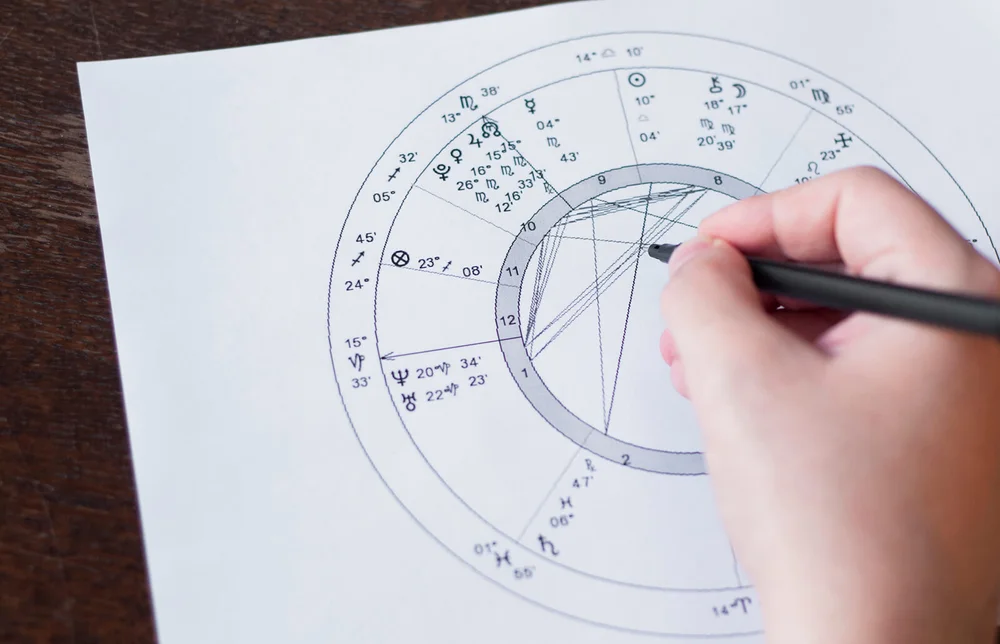
A natal chart can look like a collection of unfamiliar symbols when someone first encounters astrology. Small circles, arrows, lines, and unusual characters represent the Sun, Moon, planets, zodiac signs, and other important points. Learning to recognize the planetary symbols makes a birth chart easier to read and helps beginners understand how astrologers organize their interpretations. Each planet has a traditional symbolic role, such as communication, affection, action, growth, or responsibility. The symbol identifies the celestial body, while its zodiac sign, house placement, and aspects contribute additional meaning. Understanding these distinctions provides a foundation for exploring astrology without needing to memorize an entire chart at once. It is also helpful to remember that planetary symbolism belongs to an interpretive tradition and is not scientifically established as a way to determine personality or predict events.
What Are Planetary Symbols?
Planetary symbols, sometimes called astrological glyphs, are graphic signs used to represent celestial bodies and other chart points. Many have been used in astrological and astronomical traditions for centuries, although their historical forms and interpretations have developed over time. A natal chart may show symbols for the Sun, Moon, Mercury, Venus, Mars, Jupiter, Saturn, Uranus, Neptune, and Pluto. Depending on the chart system, it may also include symbols for the lunar nodes, Chiron, or other calculated points. These glyphs make it possible to display many placements within a compact circular diagram. Instead of writing each planet’s full name, a chart uses a small symbol next to its zodiac position. Learning the most common glyphs allows readers to identify the main components before moving on to interpretation.
The Sun Symbol and Its Meaning
The Sun is represented by a circle with a dot in the center. This simple symbol is commonly interpreted as representing the solar body and its central place in the solar system. In astrology, the Sun is associated with identity, vitality, conscious purpose, and the development of a sense of self. The Sun sign is the placement most frequently used in popular horoscopes, but it is only one element of a natal chart. Its meaning is traditionally interpreted through the zodiac sign it occupies, the house in which it appears, and its relationships with other planets. For example, a Sun placement in a particular house may be associated with themes connected to that area of life. Such interpretations are symbolic and should not be treated as objective measurements of a person’s abilities or future.
The Moon Symbol and Emotional Themes
The Moon is represented by a crescent shape. In astrology, it is traditionally connected with emotional responses, instinctive habits, comfort, memory, and the need for security. Its sign is often used to explore how someone may seek familiarity or respond to changes in their environment. The Moon moves through the zodiac more quickly than the Sun, so its position can change significantly over a short period. This makes the exact birth date and sometimes the birth time important when calculating the Moon sign. In a natal chart, the Moon’s house and aspects are also considered. For example, astrologers may connect the Moon with home and family themes when it appears in the Fourth House. These are conventional astrological associations rather than scientifically verified explanations of emotional behavior.
Mercury and the Symbol of Communication
Mercury is commonly represented by a glyph featuring a circle, a cross, and a curved shape above the circle. In astrology, Mercury is associated with thinking, language, learning, communication, and the exchange of information. Its placement is traditionally interpreted as describing a person’s communication style or approach to processing ideas. Mercury in Gemini, for example, may be associated with curiosity and verbal flexibility, while Mercury in Capricorn may be interpreted through practical or structured thinking. These descriptions are general symbolic themes and do not measure intelligence or guarantee a particular ability. Mercury is also well known in popular astrology because of the phrase Mercury retrograde, which refers to an apparent backward movement of the planet from Earth’s perspective. Astrology attaches symbolic interpretations to this phenomenon, but there is no reliable scientific evidence that it causes communication problems or everyday disruptions.
Venus and the Meaning of Attraction
Venus is represented by a circle above a small cross. The glyph is also commonly used as the female symbol in other contexts, although its meaning depends on the setting. In astrology, Venus is associated with affection, attraction, relationships, aesthetics, pleasure, and personal values. Astrologers may examine its placement when discussing what someone appreciates in relationships or how they express affection. Venus in Libra is traditionally associated with harmony and cooperation, while Venus in Taurus may be linked with stability, comfort, and sensory enjoyment. These are interpretive conventions rather than fixed descriptions of romantic behavior. Venus can also be used symbolically to explore artistic interests, spending preferences, and the things a person finds beautiful. Its house placement provides additional context about the life areas in which these themes may be emphasized in an astrological reading.
Mars and the Symbol of Action
Mars is represented by a circle with an arrow pointing outward. In astrology, the planet is traditionally associated with action, energy, ambition, courage, competition, and assertion. It is often interpreted as a symbol of how someone pursues goals, responds to obstacles, or expresses determination. A Mars placement in Aries may be described through directness and initiative, while Mars in Taurus may be associated with persistence and a steady approach. These descriptions should not be confused with scientific predictions about aggression or physical ability. Mars can also be interpreted through motivation and the willingness to act on decisions. In a birth chart, astrologers consider its zodiac sign, house, and aspects to understand how these symbolic themes interact with the rest of the chart. The glyph identifies Mars, but the full interpretation depends on the wider context.
Jupiter and the Symbol of Growth
Jupiter’s glyph resembles a curved form connected with a cross. In astrology, Jupiter is traditionally associated with expansion, opportunity, learning, optimism, philosophy, and the search for meaning. Its placement is often interpreted as highlighting areas where someone may seek growth or develop broader perspectives. Jupiter in Sagittarius, for example, is commonly connected with exploration and enthusiasm for learning, while Jupiter in Virgo may be interpreted through practical improvement and attention to useful knowledge. These associations are symbolic rather than guarantees of success or good fortune. Jupiter’s influence is sometimes described in overly positive terms, but no planet placement can ensure favorable outcomes in education, work, relationships, or finances. A balanced chart interpretation considers both the symbolic possibilities and the practical circumstances that shape real decisions.
Saturn and the Symbol of Responsibility
Saturn’s glyph includes a curved form and a cross-like structure. Astrologers traditionally connect Saturn with responsibility, boundaries, discipline, patience, limitations, and long-term effort. Its placement is often interpreted as identifying areas in which someone may need to develop maturity or build reliable structures. Saturn in Capricorn, for example, is commonly associated with organization and ambition, while Saturn in Cancer may be interpreted through themes of emotional boundaries and security. Such interpretations are not evidence that a person is destined to face particular hardships. Saturn is sometimes portrayed as a negative influence in popular astrology, but its symbolism also includes persistence, skill development, and the benefits of consistent work. Understanding this broader range of meanings helps beginners avoid interpreting every Saturn placement as a prediction of difficulty.
Uranus and the Symbol of Change
Uranus is represented by a more complex glyph that differs in appearance across some chart styles. In modern Western astrology, it is associated with innovation, independence, sudden change, unconventional thinking, and the desire to break away from established patterns. Astrologers may interpret its placement as highlighting areas where freedom or originality becomes a central theme. Uranus takes many years to move through a single zodiac sign, so its sign is shared by large groups of people born during similar periods. For that reason, astrologers often place greater emphasis on its house and aspects when making an individual chart interpretation. Its symbolism can provide a way to explore questions about independence and change, but it cannot reliably predict technological developments, unexpected events, or personal decisions.
Neptune and the Symbol of Imagination
Neptune is commonly represented by a trident-like glyph. In modern Western astrology, it is associated with imagination, dreams, spirituality, idealism, compassion, and uncertainty. Its symbolism is often used to discuss creative inspiration and the desire to look beyond ordinary experience. However, Neptune can also be associated with confusion, unrealistic expectations, or difficulty distinguishing an ideal from practical reality. A placement involving Neptune may therefore be interpreted in more than one way, depending on the rest of the chart and the astrological tradition being used. Like Uranus, Neptune moves slowly through the zodiac, making its sign a generational placement shared by many people. Astrologers often consider its house and aspects when exploring how its themes are represented in an individual chart.
Pluto and the Symbol of Transformation
Pluto’s astrological glyph appears in several forms, depending on the chart style. Modern Western astrology commonly associates Pluto with transformation, power, control, deep psychological processes, and the ending of one phase before another begins. These themes can sound dramatic, but they should not be treated as predictions of crisis or unavoidable life changes. Pluto moves very slowly through the zodiac, so its sign is shared by people born over an extended period. Individual interpretations therefore often emphasize its house placement and relationships with personal planets. Some astrologers use Pluto to explore how people respond to change, confront difficult patterns, or reconsider their relationship with power. Others give it less importance, particularly within traditions that focus on the classical planets. Its significance depends on the interpretive approach.
Why the Glyph Alone Is Not Enough
Recognizing a planetary symbol is only the first step in reading a natal chart. The same planet can receive different traditional interpretations depending on its sign, house, and aspects. Venus in one sign may be interpreted differently from Venus in another, while Venus in the Fifth House is associated with different life themes from Venus in the Tenth House. A planet’s angular relationships with other planets can also affect the way astrologers describe its role. These layers explain why a chart cannot be understood by memorizing a list of glyph definitions alone. Beginners should start with the Sun, Moon, Mercury, Venus, and Mars before exploring the outer planets and additional chart points. Learning gradually makes the process easier and reduces the temptation to assign dramatic meanings to individual symbols without context.
How to Read Planetary Symbols in Your Own Chart
Begin with a natal chart calculator and make sure the birth information is as accurate as possible. Find the Sun and Moon glyphs first, then identify Mercury, Venus, and Mars. Compare each planet’s symbol with a reliable chart key and note the zodiac sign beside it. If the chart includes house numbers, record those placements as well. Read a basic explanation of each planet and consider how the sign and house modify its traditional symbolism. There is no need to interpret every aspect immediately. You can choose a few placements and explore them in more depth before moving on to the rest of the chart. Keep in mind that astrology is not a scientifically validated method for diagnosing personality, predicting relationships, or making financial decisions. Treat the exercise as an introduction to a symbolic tradition rather than a source of certainty.
Conclusion
Planetary symbols make natal charts easier to read by representing the Sun, Moon, and planets through recognizable glyphs. Each celestial body has traditional associations, from identity and emotion to communication, affection, motivation, growth, responsibility, innovation, imagination, and transformation. However, the glyph itself provides only the starting point. Its zodiac sign, house placement, and aspects contribute additional layers to an astrological interpretation. Beginners can develop their understanding by learning the main symbols first and gradually exploring how the different chart components work together. Astrology remains a symbolic belief system rather than a scientifically established method for explaining personality or predicting the future, but learning its visual language can help interested readers understand natal charts and the traditions behind them.